Browse Items (112 total)
- Collection: Physical Object: Flora MacDonald's prayer book
This painting of skies near Mallaig was gifted to the West Highland Museum by the artist’s widow Magda Salvesen in1994. Jon Schueler (1916–1992) was…
This very large oil painting by Henry Tanworth Wells (1828–1903) hangs at Arisaig House. It was a wedding gift to Gertrude Astley from her sisters…
This portrait titled “Mrs Ryan” has been selected because the sitter and artist have close links to Lochaber. Keith Henderson (1883–1982) was a…
“October in Knoydart”, is an oil on canvas signed by the artist. It depicts Lochaber’s wild mountainous scenery and was selected for the gallery…
This local Lochaber scene depicts women waulking cloth on the shores of Loch Nan Uamh. Six women are seated in a rough circle wielding short mallets…
This was championship belt was won by strong man Alexander Anthony Cameron (1877–1951). He was one of the all-time great strongmen and athletes from…
In 1929 the Lochaber aluminium smelter opened in Fort William. The British Aluminium Company had developed an area of 303 square miles around Ben…
This gorgeous dress was made in India, but has connections with the Highlands. It belonged to Barbara Morrison, who had been born in Inverness. She…
This Ben Nevis race medal was won by Lucy Cameron. She won the women’s race in 1902 in the record time of 2 hours and 3 minutes. The first competitive…
This heavy dirk with a backed blade is made from steel with a wooden hilt decorated with a Celtic knotwork design and brass pins. The dirk is…
The birching table is from the old court house in Fort William where the birchings were carried out. It was last used in 1948, when a 15-year-old boy…
Blog by Madga Salvesen, Curator Jon Schueler Estate
This object has been included in the gallery because its purpose is a bit of a mystery. It is believed to be a type of wooden quern made from bog oak.…
This beaker was found in a cist in a gravel knoll above the Nether Lochaber Hotel, Corran near Fort William in February 1889. It is very special as…
This prehistoric sword would have been a lethal tool of combat. It is a Bronze Age sword and one of the earliest examples of craftmanship in metal by…
This is one of the oldest medals in competitive shinty. Shinty, or camanachd as it is traditionally known in the Gaelic-speaking West Highlands, is an…
These decorated silver ceremonial spades were used to cut the first sods of local railway lines in the late 19th century. The first spade was used to…
Charms were an integral part of Highland culture for centuries. There are a good variety of charms in the museum, covering everything from preventing…
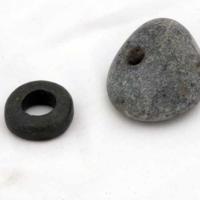 Charm Stones
This is a beautiful example of a 19th century child’s tartan dress. The full skirt with flared sleeves is hand stitched. The tartan sett is Murray…
This is a typical example of a 19th century Highland outfit made for a child. It comprises of a kilt, jacket, sash, sporran, and Glengarry. It…
This is an example of Chinese export porcelain designed to Western taste. This is armorial ware or heraldic china where the ceramic is decorated with…
This 18th century banner contains the Coat of Arms of MacDonald of Moidart. By tradition this is Clanranald’s Banner which was raised beside the…
This is a coffin guard or mort safe and is designed to prevent body snatchers stealing the corpse of someone who has recently died. In the early…
This tiny silver water cruet was found by chance in a local river. It was used by a priest to officiate at communion. It is engraved with the letter…
 Corran Beaker 3D
Bronze age beaker
Metal knife blade with no handle. Although the knife is poorly constructed and rusting its important because it was purportedly found on Drumossie…
A prayer book titled “A Manual for A Christian”. The prayer book was rebound in the 19th century when the inner and outer case were added. Sadly, no…
Stretcher invented by Donald Duff (1893-1968) and used by Lochaber Mountain Rescue team (LMRT) whose patch includes Ben Nevis. Duff was a doctor,…
These postcards are part of a much larger collection sent by John McCallum to his wife Mary from France during the Great War. They married in…
A framed fragment of cloth decorated with brown sprigged stripes on a cream background. It is mounted on a glazed wooden and silver frame. The piece…
“Little Office of the Immaculate Conception of the Blessed Virgin Mary” prayer book. Originally bound in plain card it has decorated with an intricate…
A pair of decorative 18th century shoe buckles with paste 'jewels'. Said to have been worn by Flora MacDonald (1722 -1790). Flora was a heroine…
Bone china fluted handle less tea cup and deep saucer said to have been part of a set that belonged to Flora MacDonald (1722 -1790).
When land around the old fort was excavated to make way for the first rail line into Fort William in the 1890s, knives, cannon, and bullet moulds were…
Large metal lock from Fort William.
This Victorian post horn is made from a cow horn and has a metal mouthpiece decorated with a caberfeidh (stag's head) and shield. It is on a shoulder…
This iconic 1st pattern F-S Fighting Knife was designed by William Fairbairn and Eric Sykes in 1940. The duo trained special forces including the SOE…
This pair of late Bronze Age gold pennular armlets were found at Kilmallie, just outside Fort William. The fascinating story behind them relates to…
This fine taxidermy specimen of a golden eagle came to the museum in 1940. There is no record as to when it was prepared, but our records show that…
A good luck charm made for Colonel John Cameron of Fassiefern (1771 – 1815). It is made from tartan silk and contains a pebble, pieces of stalk,…
This is a rim and shoulder of a late Bronze Age hanging bowl that has been spun from a single piece of bronze. There is one escutcheon with a ring…
This hard-tartan dress was handmade on the Scottish island of Benbecula in the early half of 19th century. It shows signs of wear, tear and repair,…
A circular box with an enamel tartan decoration. The hinged cover opens to expose a plain interior. However, the hidden double lid opens to reveal a…
A paper and ivory fan depicting Prince Charles Edward Stuart (1720 - 1788) with the Mars, Roman god of war, and Bellona, Roman goddess of war. They…
This blackthorn walking stick belonged to the famous Scottish Gaelic bard Iain Lom MacDonald (1624 – 1710). He carried it by him after the Battle of…
A fine example of a mid-18th century drinking glass with an air twist stem, engraved with Jacobite symbols. Drinking toasts to the exiled Stuart…
This rare and exquisite memorial tie pin was commissioned by Queen Victoria (1819 – 1901) on the death of John Brown (1826 – 1883). The Queen gifted…
This is the Highland outfit Queen Victoria (1819 – 1901) presented to her trusted Scottish servant, John Brown (1826 - 1883), on the occasion of her…
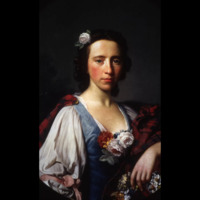 Latin Prayer 1
 Latin Prayer 2
The iconic Lochaber axe has been included in the gallery because it is still an important symbol of the area today, even appearing on the West…
The iconic Lochaber axe has been included in the gallery because it is still an important symbol of the area today, even appearing on the West…
Tortoiseshell framed spectacles with a leather case said to have belonged to Lord Lovat. Simon Fraser, 11th Lord Lovat, (1667 – 1747) was chief of…
This is a MacInnes Massey all metal ice axe. The Massey was one of the first metal-shafted ice axes manufactured in Britain. These ice axes…
This map shows the estates belonging to Cameron of Lochiel that were forfeited after the 1745 uprising. Lochiel had led Clan Cameron throughout the…
Three examples of portraits after the engraving by Robert Strange (1721 -1792). Strange’s engraving was based on the Allan Ramsay (1713 – 1784)…
This trooping helmet belonged to James Graham, 1st Marquis of Montrose (1612-1650). Montrose was a Scottish nobleman, poet and soldier. He initially…
Musettes are small, elegant bagpipes that were fashionable in French court circles in the 17th and 18th centuries. This set of French bellows-type…
This is a series of four panoramic photographs documenting Princess Margaret's visit to Fort William in 1965. They are important to our photographic…
This beautifully decorated clarsach, or Scottish harp is in the style of the Queen Mary harp, the original design of which dates from the reign of…
This is a very fine portrait of Clementina Walkinshaw (1720–1802), by renowned Scottish artist Allan Ramsay (1713 – 1784). Clementina became the…
Portrait of Donald Cameron of Lochiel (1695–1748), ‘The Gentle Lochiel' in a gilt frame. Although this is a copy of a George Chalmers (1720–c.1791)…
A beautifully carved powder horn with a detailed Celtic design. Powder horns were generally made from horn and used to store gunpowder. This…
This powder horn has been showcased in the gallery because it is so beautifully decorative. The horn has been carved in a deeply incised rose design…
This fragment of plaid was gifted to the Museum in 1973 as part of a Bequest from Dr Charles Hepburn, a collector of Jacobite memorabilia. The sett…
Royal Stewart sett hard tartan trews with integral 'feet'. Traditional trews were not trousers, but long hose which were worn high up to the waist.…
A pale green striped silk waistcoat that has been embroidered with rosebuds and silver thread. It is a textile with a fascinating history. The…
Queen Victoria (1819 - 1901) certainly had a love of horse riding and was an accomplished equestrienne. This gold mounted riding whip belonged to the…
This heavy brass sporran cantle with an incised pattern once belonged to the legendary Highland outlaw Rob Roy MacGregor (1671 - 1734). Tradition has…
This an early modern shoulder-belt plate that was found in 2015 by metal detectorists in the deserted township of Alisary. It is very rare because it…
Silver quaichs are used by Scots to take a wee dram of whisky. This silver quaich has a fascinating story to tell and is said to have been drunk from…
This is a silver baluster snuff mull with the heraldic arms of Cluny MacPherson set within a foliated scroll formed cartouche. The museum purchased…
This hard-tartan box pleated Stuart kilt in the Duke of Rothesay tartan and is said to have been worn by the Sobieski brothers. The tartan is their…
These are two silver Spanish pieces of eight found in Tobermory Bay off the Isle of Mull. The coins made an unusual journey to arrive in the West…
This spinning wheel used for spinning thread or yarn from fibres was made in the French pattern, and was gifted to the West Highland Museum along with…
By the late 1890s a unique system of mail dispatch had developed on the remote Scottish archipelago of St Kilda. Letters were enclosed in a waterproof…
This leather-bound stalker’s telescope has been selected because of its association with the Highlands. It is a typical example of equipment ghillies…
This Neolithic stone axe was found at Keppoch near Roy Bridge in 1876. It came into the museum’s collection in 1936. Axes were adapted for many uses…
A hard tartan jacket made in Uist. With linen lined sleeves. The colourful tartan lining differs between the skirts and bodice. It is a fantastic…
This gun by tradition is the Appin murder weapon. The Appin murder took place on 14 May 1752 in the aftermath of the 1745 Jacobite Rising. It is an…
This decorative dirk is part of a Highland outfit. In addition to the blade there is small knife and fork that fit neatly into the leather scabbard.…
This object is a bit of a mystery. Known as the Clanranald Anvil, it probably dates back to the 14th or 15th century. It is a very heavy irregular…
Said to have been made more than 800 years ago, the Faery bagpipes of Kinlochmoidart, are very special as they are thought to be one of the oldest set…
A large round boulder with a hole bored partially through it. This is a stone with an iconic history. It was originally from Glenfinnan and by…
This is the largest object in the West Highland Museum collection and maybe one of the most intriguing. It came from the old fort (An Gearasdan) at…
This basket hilted broadsword dates from either the late 17th or early 18th century. Basket-hilts were swords with a basket-shaped guard to protect…
Prince Charles Edward Stuart's (1720 - 1788) death mask. Thought to be a copy of an original made by Barnar dina Lucchesi, one of a family of…
A tooth mounted in a hand-carved ivory frame. The tooth is said to have belonged to Prince Charles Edward Stuart (1720 - 1788). It is very rare and…
An anamorphic hidden painting of Prince Charles Edward Stuart (1720 - 1788). At first glance the object appears to be a smear of oil paints on a…
A copper printing plate commissioned by Prince Charles Edward Stuart (1720 - 1788) in 1746. Designed and etched by the artist Robert Strange (1721…
Print made by the prominent Scottish artist and etcher Sir D Y Cameron (1865 -1945). In 1928 The Strange Plate came into the museum’s collection,…